Thursday, 18 October 2012

Max Beerbohm's Illustrated Zuleika Dobson...love the pictures.


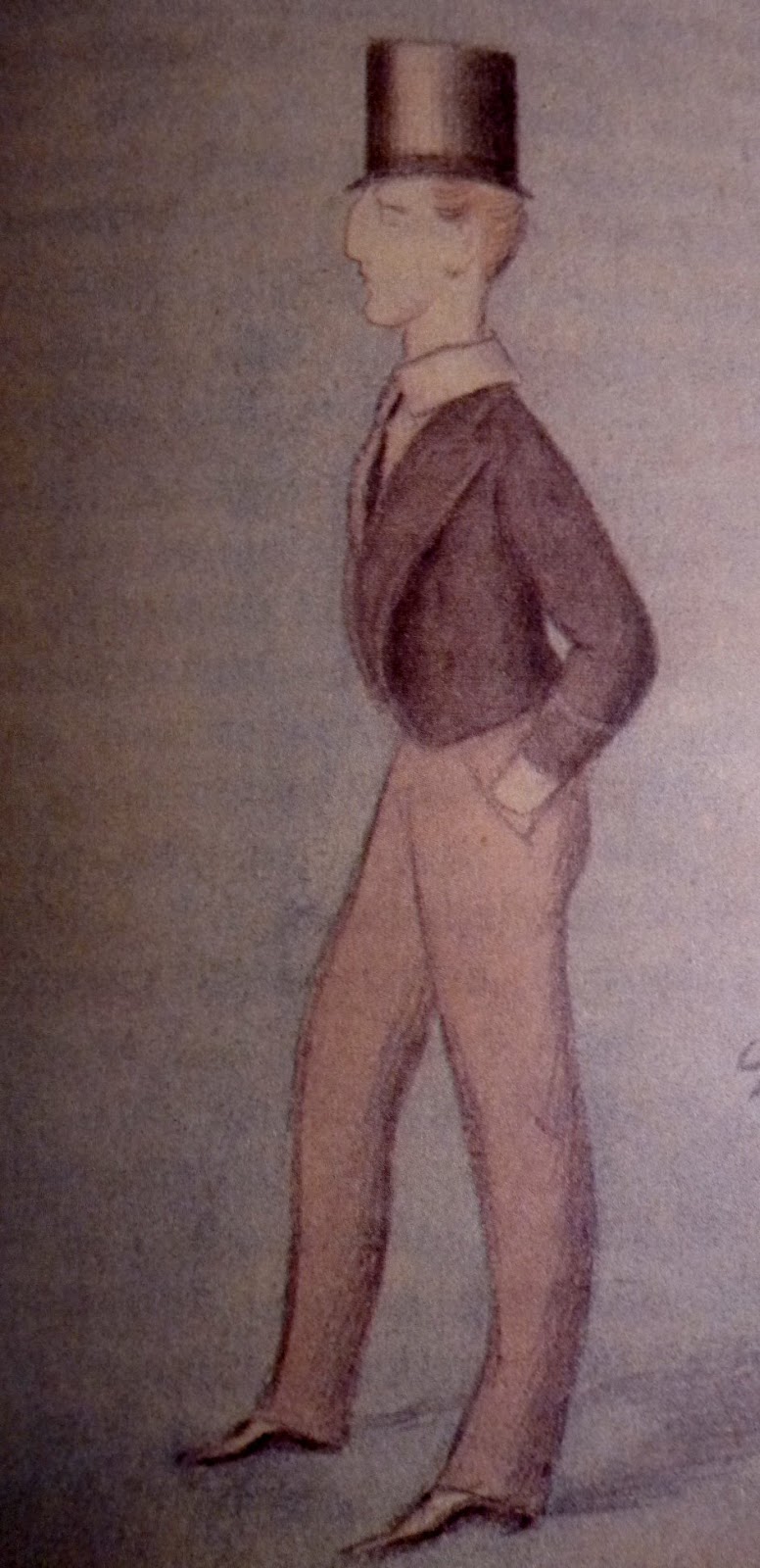
Earlier this month I reviewed Max Beerbohm's singular novel of Zuleika Dobson (here). I was at the Tasmanian State Library the other day and found an edition of The Illustrated Zuleika Dobson which is the version of the book Mr. Beerbohm illustrated with his caricatures. The pictures are absolutely charming.

Max Beerbohm was known for his caricatures, essays and short stories and he only wrote one novel in his life. I enjoyed these illustrations so much I thought I would share them here for a bit of fun. Enjoy.

Zuleika
The Duke


Zuleika's grandfather
collects her at the train station.
A night out.

2 black owls appear for a night before the death of a Duke

..................as do all the young men of Oxford also
drown for Zuleika

The Duke throws himself into the river
for Zuleika ....


Zuleika with her maid Milisande. Now all the Oxford men
are gone whatever will she do now she bemoans.

Wednesday, 17 October 2012

Across Lapland - A Vintage Penguin Travel & Adventure

The cerise Penguin cover indicates the book is a Travel & Adventure story. They are a great coloured cover and the stories are non fiction generally based on some pretty amazing feats people have achieved.

Vintage Penguin No. 226, published 1939
Across Lapland is written by English woman Olive Murray Chapman. Although it was originally published in 1932, Penguin published it in 1939.

Ms. Chapman, an English woman decided she wanted to take a reindeer across Lapland in the Arctic. The places she covered went from Narvick in Norway, to Kiruna in Sweden and across to Kautokeino, Karasiok to Alta, Bossekop and finishing at Hammerfest in Finmark (the name at the time).

Her plan was to cross this area in the winter/spring by herself with a team of reindeer and one guide. The time was the winter/spring of 1931.

According to the description by Penguin, the "object of her journey was to study the life of the primitive nomad Lapps, and to obtain a pictorial record of the people and their customs. She travelled with a still camera as well as a  moving picture camera and upon her return the pictures were shown before the Royal Geographic Society, which at the time would have been quite an honour especially for a woman.
The reindeer and sledges coming in at night with supplies
before the journey begins.
The book contains several of her black and white photos.
Amidst many discouraging remarks from everyone who heard of her proposed quest, she was successful and   completed a very remarkable journey in some incredibly daunting winter weather as well as shoddy accommodation.
I enjoyed this story. I am a great travel reader and the more arduous the journey the more I am attracted to the story. Explorers in this time period were not filmed for television nor did they travel with support crews and photographers that helped them with the creature comforts of home. (Think Charley & Ewan).
A night's accommodation after a snow storm.

I often gravitate to books about travellers, especially women who do remarkable trips walking, bicycling, motorbiking around the world in remote and dangerous places.  I like to travel as much as the next person but some of the trips I read about I am far happier to live vicariously through the pages of an old book. The Penguin books were great to curl up with on a rainy day to enjoy the adventure.

I found a great deal of the book enjoyable but got a bit bored when she would write endlessly about a costume someone wore and I cringed at times when she would barge into a wedding with her Woolworth necklaces to accost the bride, throwing her gift over their head in the midst of a procession.
Inside the night's accommodation on the trail.
Can be shared with several others. Bunk slats built into
the wall.

Although her journey was brave, I found her quite irritating at times. I don't know if it was the way she wrote her story, her expectations of the people around her or just the way she seemed to assume that everyone was delighted to see this English woman come into their remote lifestyle.   She struggled with some of the food, mainly lightly cooked to raw reindeer meat boiled in water. She seemed to eat a lot of boiled eggs and drink heaps of tea. Although she often had coffee offered to her she said it tasted kind of funny and preferred her tea.

Her trip to the journey's beginning aboard some of the ships she had to take were adventure enough for me and sounded far harsher at times than the actual journey across the arctic in her fur wraps and galloping reindeer.
Women marry a man with 1000 reindeer for wealth if they can.

I guess my own philosophy is if you're in somebody else's culture and they offer you their food and drink you oblige as part of respecting what you are being given especially when people have so little. Most of the time she would oblige but sometimes I did think, "Don't be so damn fussy. Put it in your mouth and swallow". "

She was quite sensitive to photographing her subjects although it was not unusual when visiting a new village that she might hide behind a shed of some sort or in a doorway to get photos without being seen.

I often had pictures in my mind of her running from tree to tree like the Loony Tunes do in cartoons, only to peer around one, snap the photo before darting off to the next tree.
Preparing for the day's journey.

There also seems to be a writing style at that period for travel writers that much of their writing is as though they are writing for a text. Very dry observations are recorded about food, clothing, customs and behaviours.  I wanted to know more about the people, how they reacted (besides, "she was very shy") and how she communicated with them. Maybe more of a point of view of how they felt about someone coming into their domain recording them as though they were lab rats.

Perhaps I am being too harsh but often I could not warm to her as I often do to other very early travellers. I did learn a great deal about early Lapland from this trip and I admired her respect for the people and animals.
She didn't seem to address her planning for this trip much and considering she was in weather of more than 50 degrees below zero F, I am surprised she fared as well as she did. Her guides were wonderful and she would have definitely perished had it not been for them.
Trading at the twice yearly Bossekop market

The scenery was stunning and very well described. I could see the snowy tundra, forests and hear the wolf calls as though I was there. I could feel her fear at times whilst bounding through the storms of snow making visibility non existent.

I would recommend this book to anyone who is interested in wilderness travelling but it would be fun to have a good old laugh at some of her antics with someone who has read it, in front of a fireplace, with a hot cup of tea.

Once again the cerise Penguin does not disappoint.

Excerpts
From pg. 27: I was allotted a berth in a tiny cabin for three, with two other women, natives of Bossekop, one of whom already looked very ill. The port-hole was securely shut, the heating full on, and the close, unventilated air impregnated with a nauseating odour, which I found later proceeded from the bundles of goats'carcases on the deck above. ...........  I determined to make it (the night) a short one, so after supper, consisting of eggs, salt bacon, dried fish, sardines and coffee, which I had with the captain and some of the merchants, I wrapped myself up as warmly as possible, and in spite of the cold, went for a stroll on deck, putting off the evil moment when I should be forced to return to the cabin with its depressed-looking occupants."

I particularly enjoyed the stories of the Lapps when they would "joik".

From pg. 75: "It was my first experience of this strange and ancient form of song, which is peculiar to the Lapps, and, although consisting of only four or five monotonous notes, can on occasions be very melodious. The words are usually composed on the spur of the moment and express the emotions of the singer, or tell of what he sees. A Lapp will often sing in praise of his reindeer and dogs, or of the warmth of the sun. At other times he will compose a song about his friends, and I was told an amusing story of a Lapp who had composed what sounded a very fine joik in honour of the Lensmann of his district. On the words being translated into Norwegian, they proved to be all about that gentleman's bald head!"

The descriptions of the scenery were always  my favourite part.

From pg. 115:  "The hours passed slowly by, and we met no one all day, until towards evening I saw some Lapps with reindeer and pulkas driving towards us. They proved to be a man and woman with a baby who, on reaching us, stopped for a chat with Johan (guide), while I delighted in the picture they  made. In the foreground were the group of reindeer and the Lapp mother who, in her furs and scarlet cap and shawl, was bending forward to rock her baby in its little skin cradle which was strapped into the front of her pulka, while Johan and the father smoking their pipes, stood quietly by talking, and throwing long blue shadows over the snow. In the background, and on either side of the great ice-bound lake over which we were travelling, were low ranges of hills whose snow covered slopes were tinged rose and purple from the setting sun, while the pale turquoise sky was streaked in the west with crimson and gold. The preceding long and weary hours were all forgotten as I drank in the glory of the scene before me, lost in wonder at the indescribable peace and beauty of it all." 
The Journey
(Click to enlarge map.)


This book applies to the Century of Books challenge 1932 (here)


Monday, 15 October 2012

The Classics Club Challenge: 50 Classics in 5 years

I have been following the Classics Club blog for awhile now and really enjoying reading the reviews of the various posts of the classic books as well as looking at the lists people have chosen to read.

As there are many books I really want to read I have decided to jump in and see how I go because it is a great way to stay focused and also see what others think of the same books. The dates of this challenge will be from 1 January, 2013 to 1 January, 2018. Although I may start this a bit earlier as we are very close to the new year, 2013 and my enthusiasm now is high.

It really is an on-line book group that I think will offer great opportunities to chat to people who are interested in more traditional (and sometimes not quite traditional) books that have been recognised as good reads over the years.

I have spent quite a bit of time devising my list of 50 and although this is the list I hope to stick to there could be the odd change within it.

Many of the books listed are from my Vintage Penguin book collection currently on my shelves TBR. Many choices are American classics as having moved to Australia so long ago I have gotten away from American literature and love it so much so am going back to revisit it. Many books are English as growing up in America we didn't read a lot of English classics in school so would like to remedy that. There are a sprinkling of other nationalities of authors as well so overall I think this list will be a great starting point.

So without further adieu these are the 50 books I have chosen.

Click on the links to see review.

1.  Adventures of Huckleberry Finn by Mark Twain (American)
2.  Tom Sawyer by Mark Twain (American)
3.  A Town Like Alice by Neville Shute (Australian)
4.  Middlemarch by George Elliot (English) (our summer book group read) Finished
5.  Moby Dick by Herman Melville (American)

6.  The Scarlet Letter by Nathaniel Hawthorne (American)
7.  To Kill A Mockingbird by Harper Lee (American)
8.  Pride & Prejudice by Jane Austen (English)
9.  Madame Bovary by Flaubert Gustave (French)
10. Sense & Sensibility by Jane Austen (English)

11. Tess of the D'Urbervilles by Thomas Hardy (English)
12. Bleak House by Charles Dickens (English)
13. Little Dorritt by Charles Dickens (English)
14. David Copperfield by Charles Dickens (English)
15. Confederacy of Dunces by John Kennedy Toole (American)


16. Old Curiosity Shoppe by Charles Dickens (English)
17. A Raisin in the Sun by Lorraine Hansberry (African-American)
18. The Red Badge of Courage by Stephen Crane (American)
19. The Jungle by Upton Sinclair (American)
20. The Old Man and the Sea by Ernest Hemingway (American)


21. The Invisible Man by Ralph Waldo Ellison (American)
22. Native Son by Richard Wright (African-American)
23. My Antonia by Willa Cather (American)
24. Beloved by Toni Morrison (African-American)
25. Hiroshima by John Hersey (American)


26. One Flew Over the Cuckoo's Nest by Ken Kesey (American)
27. Gone To Earth by Mary Webb (English)
28. Tobacco Road by Erskine Caldwell (American)
29. I Can Jump Puddles by Alan Marshall (Australian)
30. Catch 22 by Joseph Heller (American)


31. Walden by Henry David Thoreau (American)
32. Turn of the Screw by Henry James (American born-became British)
33. Little Women by Louisa May Alcott (American)
34. If Beale St. Could Talk by James Baldwin (African-American)
35. Steinbeck: A Life in Letters by John Steinbeck (American)


36. As I Lay Dying by William Faulkner (American)
37. Claudine & Annie by Collette (French)
38. The Wayward Bus by John Steinbeck (American)
39. Seven Little Australians by Ethel Turner (Australian)
40. The Harp in the South by Ruth Park (Australian)


41. Letters of Rachel Henning by Rachel Henning (English born-moved to Australia)
42. Confessions of a Beachcomber by E. J. Banfield (born England-moved to Australia)
43. Farewell To Arms- Ernest Hemingway
44. Love in the Time of Cholera by Gabriel Garcia Marquez (Columbia, S America)
45. The Plague by Albert Camus (French)


46. The Trial by Franz Kafka (German Jewish - Lived in Prague)
47. Things Fall Apart by Chinua Achebe (Nigerian)
48. Woman in a Lampshade by Elizabeth Jolley (born in Englan- moved to Australia)
49. Germinal by Zola (French)
50. Narrative of Life of Frederich Douglas by Frederich Douglas (African-American)


Saturday, 13 October 2012

October Challenge Goals Continue with Penguins & Plants

Well this week has seen a few more of the alphabet goals (here) for October knocked off.  The first goal of the weekend I am crossing off is (Goal J- Join in a discussion with someone, anyone, about a book.)

Today I went to Salamanca Market with my friend K. and her daughter S.  As we sat on the lawns eating our mini pancakes with ice cream and maple syrup I asked 13 year old S., year 7,  what she has had to read for school lately. We then talked about the appropriateness of this book for her age group.

Her assigned book was Witches by Roald Dahl.  She told me it is a chapter book but she got bored because she has read this book about 10 times already and was ready for something with a bit more substance.

I asked her why a Grade 7 child wouldn't read something more challenging and she said the teachers need to assign something that will appeal to everyone however she didn't agree with this choice. She is a very prolific reader and was keen to get stuck into something else. I guess this is a problem if only one book can be chosen and there are many different levels of reading ages in the class. How do you prevent the excellent readers from getting bored? An age old question.
Is this why people stop reading? Do they get books assigned that are too easy and so they don't really get into thinking about it? Or are books too hard so everything goes over their head?  I don't have children and my dogs and cats aren't reading yet, as much as I think they'd like to at times from the way they have carried some of my books around.
How does one select appropriate reading material for a grade 7 curriculum when students are coming out of the simpler, more illustrated books into books with more text?

After our book discussion we continued through the very busy market and I found some plants to put into my back garden. (Goal S- Saturday Salamanca Market - Go- Buy one Penguin and at least one plant for garden)

Ronunculus are just coming out now
Love the little cat's whiskers pansies
I found three strawberry plants that I am anxious to plant. However when I got home I was able to plant the flowers I purchased yesterday because the area where I am putting those is under cover.
However the strawberry plants will need to wait until tomorrow.

The other part of the Salamanca Market goal was to find another vintage Penguin book I didn't have. I actually found four. I love the covers of all of them and they look like good reads too. Both the books and the stories are new to me.
Penguin No. 1428 Published 1960- 1st
So the Salamanca market was a big hit with both of my dear friends finding things they wanted too and after eating the pancakes then ate Huon Valley tempura mushrooms, very fresh. The food in Tasmania is always first rate so if you don't succeed shopping you are certainly guaranteed good eating.

 I also had a pleasant afternoon lying in a lounge chair in the front yard the other day that is fenced for a lovely play area for my dogs. (Goal L- Lie in the sun and read. It might make summer get here quicker)
I finally found time and sunshine to lie in after the cold cloudy days and rain we've had recently.  I finished up Zuleika Dobson out there while my dogs kept bringing me their toys to throw. Finally I convinced them they must entertain themselves so I could concentrate on the book.
I am happy to say I have now finished Alphabet goals J, L and S in the past couple of days.
Penguin No. 2815 Published 1968-1st

I chatted to my friend, K, who also loves books, about the on line Classics Club Challenge (here) moderated by Allie, Jillian, Adam, Melissa, Sarah and Heather.

Part of me really wants to do it (read 50 classics in 5 years) but I have to admit I find the thought quite intimidating. However after reading Laura's post on Musings (here) today I feel more inspired.  For some reason I always think the classics are big door stopper chunks of books that take ages to digest. But I do have a lot of the classics amongst my Penguin books collection on the shelves and I have always wanted to read more American classics and some of the English classics as I never got around to most of them due to my profession in the health area. Too busy learning neuroanatomy in school as well as staying abreast of current research in the speech pathology field.
Penguin No. 1788 Published 1962- 1st
Penguin No. 2619 Published 1968- 1st
So I guess it's now or never if I want to do this, and I really do want to read these books. I think this group would be great motivation. So I have decided to start my list of the 50 books and begin it with the new year, 2013. Seems like an appropriate time.
I am really enjoying having books taking up so much of my retirement as I read a great deal in my youth and now am ready to revisit those happy days of reading that I remember so well and fell out of in the intervening years. So stay tuned...


Wednesday, 10 October 2012

October Challenge Z - Zuleika Dobson by Max Beerbohm

Penguin Number 895
Max Beerbohm essayist and caricaturist wrote one novel during his lifetime, 1872 - 1956. The novel was Zuleika Dobson, (also known as an Oxford Love story. It is the story of a beautiful young woman whose very presence causes men to fall over with lust and love.
I chose this book because my friend Karyn of apenguinaweek suggested it would be a good book to read as one of my tasks for my October challenge of reading a book whose title begins with Z. I don't have many books with Z titles on my shelves.  It sounded more interesting to me at the time than Zorro.

Zuleika was written in 1911 so it also meets the Century of Books challenge. Penguin published it on 24th August 1952 in honour of the author's 80th birthday.

I began this book thinking, "Oh boy, this is going to be tedious." Yes there were many parts of it that were but having just read Before the Bombardment this one moved along much quicker so I did get into it quickly. Zuleika is a young woman in Edwardian England, who visits her grandfather, the Warden of Judas at Oxford.

As she stepped off the train; "A hundred eyes were fixed on her, and half as many hearts lost to her. The Warden of Judas himself had mounted on his nose a pair of black-rimmed glasses. Him espying, the nymph darted in his direction. The throng made way for her. She was at his side. "Grandpapa! she cried, and kissed the old man on either cheek. (Not a youth there but would have bartered fifty years of his future for that salute.)"

Max Beerbohm 1872-1956
She has the ability to turn men to fools with lust, desire and love at first sight.  However when she meets the Duke of Dorset  although he feels the same way,  he hides it and she believing he is not in love with her as the others, falls for him simply because he does not seem to care. This see-sawing of feelings continues upon several subsequent meetings.

The story then becomes quite fantastical in that all of the young men at Oxford fall in love with her, completely in vain and they all decide they must follow the Duke,who has decided he must die for her by calling out Zuleika's name and killing themselves by throwing themselves into the river during the festival of boat races.

One of M. Beerbohm's
caricatures 
Although Penguin books described this story as a romantic love I didn't interpret it much as a true romantic love in any event. It almost becomes a game of  one-upmanship between Zuleika and the Duke and the author, Beerbohm describes the story more as a fantasy.  I found the behaviour of everyone as well as the decisions they make all a bit much and became irritated by it.

I didn't think any of the characters were very likeable or convincing and the humour is quite black. However I did find myself thinking about the characters. I think more so for the 'over the top' story. It is just so unbelievable it became funny.

The description of Zuleika sums her up quite well I think. The duke asks her, "Have any of your lovers ceased to love you?"  'Ah no, no; not in retrospect. I remain their ideal, and all that, of course. They cherish the thought of me. They see the world in terms of me. But I am an inspiration, not an obsession; a glow, not a blight." 


As all of the young men at Oxford jump into the river to drown she barely seems moved by any of it, however I must stop here as I don't want to give away the ending which makes the book worth continuing.

Is it possible to enjoy a book, finish it and then think, "Well that was silly?" I am glad I read it and yes, I did enjoy it.
Another caricature drawn by
Max Beerbohm. The way he used colours
changed as he aged.
In looking up information about the author I was very surprised to learn that this book is listed in the top 100 books people should read as published by the Modern Library.  When I think of how many incredibly great books there are, the fact that this sole novel of Beerbohm's should be amongst the top 100 baffles me. I would love to have heard the reason given for that choice.

The Encyclopaedia Britannia describe Beerbohm as an "English caricaturist, writer, dandy, and wit whose sophisticated drawings and parodies were unique in capturing, usually without malice, whatever was pretentious, affected, or absurd in his famous and fashionable contemporaries. " 

One can certainly see that description in his drawings and very much in his novel. I have not read any of his essays he was also known for but I think that may be quite an interesting task.

Upon further digging through on line searches it sounds like the author's personal life is far more interesting than the book he wrote. His caricatures are great fun, evidently he was an extremely secretive man, with many believing he was a homosexual or asexual, thus hiding his sexuality and much of his personality in his three marriages. His third marriage only weeks before he died. He also supposedly had an interesting if not controversial friendship with Oscar Wilde and other artists of his time.

I think it would be most interesting to read a really comprehensive biography of the man.  From the point of view of learning more about this man, this dandy, I am happy to have read the book that led me to look up more information about him.


Oops ...Travellin' Penguin accidentally bursts
into another caricature.  We both like this one.
Thanks Karyn for your suggestion as it has been fun.  I also enjoyed Karyn's review (here) of this book which I just read after I wrote mine. I don't like reading reviews before I write mine. It is more fun to seek them out after the fact to see what others thought.
I am also happy to have finished goal Z - to read a book I own whose title begins with Z.  However if I do this again I may read Zorro next time.